
About us

From Idea to Prototype
in Just a Week

At Self Learning Tree, we believe that growth begins with learning. Our mission is to help individuals and organizations unlock their potential through practical knowledge, structured training, and continuous personal development.

We focus on empowering professionals and teams with the tools they need to adapt, improve, and succeed in an ever-changing environment. Through coaching, assessments, team training, and certification programs, we support the development of skills that drive both personal and professional progress.

Our approach is built on the idea that learning should be continuous, practical, and accessible. By combining experience, modern training methods, and a results-driven mindset, we help people build confidence, strengthen capabilities, and reach higher levels of performance.

At Self Learning Tree, we are committed to creating a supportive learning environment where knowledge grows, ideas develop, and success becomes achievable for everyone.

We Help You to Develop Successful Products Fast

At Self Learning Tree, we help individuals and teams turn ideas into successful products efficiently and with confidence. Our approach combines structured learning, practical guidance, and proven methodologies to accelerate development while maintaining high quality and clear direction.

  • We support organizations throughout the product journey — from early concept and validation to development, testing, and market readiness. By focusing on collaboration, innovation, and continuous improvement, we help teams reduce uncertainty and move from idea to execution faster.
  • Our programs, workshops, and training sessions are designed to equip professionals with the skills and tools needed to build products that solve real problems and deliver real value.
  • With the right knowledge, strategy, and teamwork, successful products can be developed faster — and that is exactly what we help our clients achieve
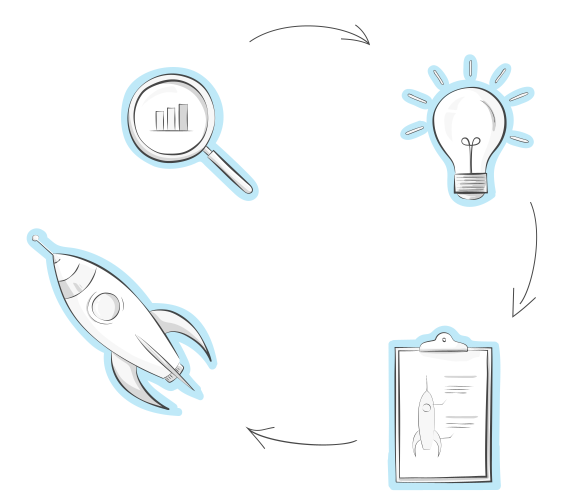
How does it work?


Our process is simple, structured, and designed to deliver results. We begin by understanding your goals, challenges, and the outcomes you want to achieve. This allows us to tailor our approach to your team, your project, and your specific needs.

1. Analyse the Target

We begin by understanding the objective, the audience, and the challenges that need to be solved. Clear analysis helps define the right direction and ensures the solution is built on real needs.

4. Test the Concept

The prototype is tested and reviewed to gather feedback and identify improvements. This step ensures the final solution is effective, practical, and ready for real-world use.

2. Find Ideas

Through creative thinking and collaborative sessions, we explore multiple ideas and possible solutions. This step focuses on innovation and selecting the most promising concepts.

3. Prototype

Selected ideas are transformed into simple prototypes. This allows concepts to be visualized and evaluated quickly before investing time and resources into full development.

1. Analyse the Target

Lorem ipsum dolor sit amet, con sectetur adipisicing elit sed do.

2. Find Ideas

Lorem ipsum dolor sit amet, con sectetur adipisicing elit sed do.

3. Prototype

Lorem ipsum dolor sit amet, con sectetur adipisicing elit sed do.

4. Test the Concept

Lorem ipsum dolor sit amet, con sectetur adipisicing elit sed do.

Frequently Asked Questions

Why should my company do a design sprint?

A design sprint helps teams solve complex problems and validate ideas in a short time. Instead of spending months developing something that may not work, a sprint allows you to test concepts quickly, gather feedback, and make better decisions before investing significant resources.

What would be a appropriate topic for a design sprint an what should be avoided?

Design sprints work best for important challenges such as creating new products, improving customer experiences, testing new features, or solving specific business problems. Topics that are too broad, unclear, or purely operational tasks are usually not suitable for a sprint.

Who should I choose to join the design sprint team?
A good sprint team includes people with different perspectives and expertise. This often includes a decision-maker, product or project managers, technical experts, marketing or business representatives, and someone who understands the customer.
Do we need a designer to create the prototype?
While having a designer can be helpful, it is not strictly required. Many prototypes are simple and can be created using basic tools. The goal is not perfection but to build something realistic enough to test the idea with users.
Does the member of the design sprint team need to be present for the entire time?
Ideally, the core team should participate throughout the entire sprint to maintain focus and continuity. However, experts or stakeholders can join specific sessions when their input is needed.
Does a design sprint make sense for a small company at all?
Yes. Design sprints can be especially valuable for small companies because they help reduce risk and make faster decisions with limited resources. Even a small team can benefit from the structured and focused approach of a sprint.

Hi! My name is Jatinder Singh and I look forward to helping you unlock the full potential of your company.